
There is a number that does not get talked about enough in whiskey circles: the monthly count of new label approvals coming out of the Alcohol and Tobacco Tax and Trade Bureau (TTB). It is not a glamorous data point. But tracked over time, it works like a leading indicator, a quiet signal of where brands are placing their bets, where capital is flowing, and what the category is about to become.
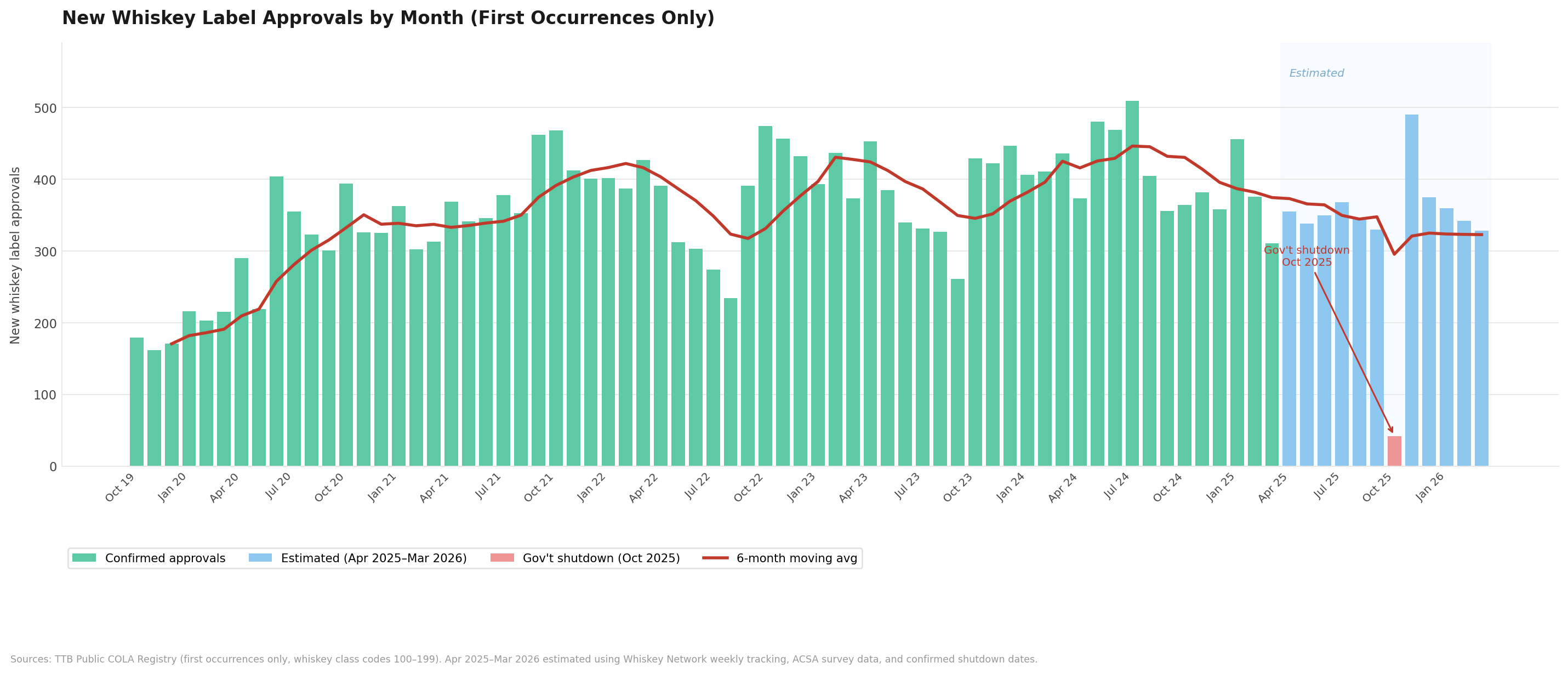
For most of the past five years, that number told an optimistic story. New whiskey label approvals ran consistently above 400 per month through 2022 and again through much of 2024, peaking above 500 late in the year. The pipeline was full. The confidence was real.
Then, in early 2025, the line started to drop. By October of that year, a government shutdown took TTB operations effectively to zero for the better part of a month, furloughing 398 of its 459 staff at the start of the industry's most critical selling season. The backlog that followed took months to clear.
What makes that chart interesting right now is not just the dip. It is what was happening in the market underneath it.
How Many Whiskey Labels Have Been Approved Monthly Over the Past 7 Years?
A Glut That Cuts Both Ways
American whiskey is working through a correction that has been building for several years. Kentucky's warehouses are sitting on a record 16.1 million aging barrels as of January 2025. U.S. bourbon production fell nearly 28% year-over-year through August 2025, the lowest eight-month output since 2018. Major suppliers like MGP have cut distilling volumes and signaled flat growth across key labels. American whiskey sales were down roughly 5% in both volume and revenue in the year through mid-2025.
For distilleries that over-invested in production capacity during the boom years, the math is brutal. For brand builders (particularly NDPs, blenders, and emerging labels looking to bring high-quality sourced liquid to market) this moment looks very different.
Barrels that commanded $4,000 or more just a few years ago are now trading hands at a fraction of that price. Well-aged 8-year Kentucky bourbon can be sourced well under $2,000 a barrel in today's market, and 4-year-old stock is accessible under $1,000 for buyers with the right relationships. The sourcing market is more favorable to brand builders than it has been in a generation.
Brands with a compelling story and the infrastructure to move efficiently through the approval process have access to better liquid, at better prices, than they would have found at any point during the boom. That is the version of this market that is not getting enough attention.
What It Actually Takes to Get to Market
Before any of that liquid reaches a consumer, it has to clear a federal approval process that most people outside the industry do not fully appreciate. The path from sourced barrel to retail shelf runs through the TTB, and it has several distinct gates.
The first is the Federal Basic Permit, required for any producer, wholesaler, or importer operating in the U.S. Under normal conditions, that process takes 90 to 180 days. With TTB's staff now operating roughly 13% below pre-DOGE levels, permit approval timelines were already pushing past the bureau's own 75-day service standard before the October 2025 shutdown added further strain.
The second gate is the Certificate of Label Approval, or COLA. Every product needs one before it can be sold across state lines. The COLA process covers label compliance (font sizes, mandatory language, alcohol content accuracy) and, for products with additives, colorings, or formulas, a separate formulation review that runs on its own timeline.
Beyond the federal layer, most states require their own brand registration before a product can be distributed within their borders, and those registrations are typically triggered by the COLA. A federal delay cascades directly into state-level holdups.
None of this is new. What has changed is the reliability of the timeline. TTB's median processing time for distilled spirits labels sits at just 2 days on paper, but the median tells a brand almost nothing useful about its specific submission, particularly if it involves any complexity around classification or formula review. The October 2025 shutdown was an extreme case, but it clarified a risk that had been building quietly for years. Smart operators are building significantly more lead time into launch planning than they were even two or three years ago.
The Enforcement Paradox
Here is where the regulatory picture gets genuinely interesting. On one hand, TTB's scrutiny on the technical details of label compliance has intensified. Submissions are being rejected over punctuation in the Surgeon General's warning, a missing apostrophe or dropped comma. This might sound trivial, but the practical effect falls hardest on smaller brands and NDPs who do not have compliance teams reviewing every submission before it goes in. A rejection does not just cost time. It costs launch windows, printing budgets, and distributor relationships built around a specific date.
On the other hand, the bureau's enforcement of category standards (the substantive definitions that tell a consumer what they are actually drinking) has grown less consistent in the opposite direction.
The central example is the Distilled Spirit Specialty designation. As Fred Minnick noted in a recent Bourbon Pursuit segment on how labeling requirements have evolved, the TTB has effectively allowed this classification to become a catch-all for barrel finishes, creative blends, and formula-based products that do not fit neatly into established categories. A product can carry "straight bourbon" language prominently on its front label while being technically classified as a specialty product finished in rum casks, port barrels, or Calvados, with no requirement to disclose percentages or proportions to the consumer.
As Minnick put it, the federal government reliably cares about two things on a label: the Surgeon General's warning, because it is a legal mandate, and the proof statement, because proof is tied to tax calculation. Category integrity sits further down that priority list, and the market is starting to feel the effects.
There is nothing wrong with finished or blended expressions. Some of the most interesting things happening in American whiskey right now live in that space. The concern is not innovation. It is transparency, and the signal it sends to a consumer base that already struggles to decode a crowded shelf.
On that front, January 2025 brought a genuinely positive development. American Single Malt Whisky officially received its own codified standard of identity, effective January 19, 2025, after years of advocacy from producers. For brands building in that space, there is now a legitimate, well-defined designation that carries real meaning. That is the version of regulatory clarity the broader category needs more of.
The Brand Builder's Calculation
For anyone bringing a whiskey brand to market (or growing one already in distribution) the current moment requires holding two realities at once.
The conditions for sourcing premium liquid are as favorable as they have been in years. The regulatory process for getting that liquid to consumers is slower, less predictable, and more technically demanding than it was when approval volumes were at their peak. Both of those things are true simultaneously, and the brands that account for both in their planning are the ones with the best shot at sustainable growth.
Differentiation has always mattered in this category. In a market this crowded, with this much supply available and this much institutional friction standing between a brand and its first sale, it matters more than ever. The approval data will eventually reflect the brands that did the work: the ones that treated compliance as a strategic function rather than a final step, built extra runway into their timelines, and paired a compelling liquid story with the operational discipline to tell it at scale.
The monthly label approval count will keep running. What it counts next is the open question.
The Keynote Collective network works with producers and emerging labels at every stage, from barrel sourcing to market strategy. Contact us to start the conversation.