
Most people choosing how to make their whiskey are answering the wrong question. They ask which path is most legitimate, or which one a serious brand would take. Neither question has a useful answer, because every one of these paths has built real brands and every one has buried them. The better question is narrower and more honest: given your capital, your timeline, and how much control you actually need, what does each path commit you to, and what does it cost you to change your mind later?
That last part is the one operators underweight. The decision to source, to contract-distill, or to build your own distillery is not really a decision about whiskey. It is a decision about how much optionality you are willing to trade for how much control, and how long you are willing to wait before you have something to sell. Get that trade right for your situation and any of them can work. Get it wrong and the best liquid in Kentucky will not save you.
There are three paths the industry talks about, and a fourth that the operators who understand this best are quietly using. Here is the map.
The three paths the industry names
Sourcing means buying finished or maturing whiskey from someone who already made it, then blending, finishing, proofing, and bottling it under your own label. You are buying time. The liquid exists, which means you can be on a shelf in months rather than years. We covered the mechanics of this in our primer on liquid options for a new brand, and the short version is that sourcing is the fastest way to test whether the market wants what you are selling.
Contract distilling means paying a working distillery to make whiskey to your specification, on their equipment, often to your mash bill and proof. You do not own a still, but you own the production decision. The liquid is made for you, not bought off a list, which means you control the recipe from the first run. You also wait for it to age, which puts you years out from a flagship release even as you may bottle sourced liquid in the meantime.
Ground-up means you build or buy a distillery and make everything yourself. Total control, total exposure. Every dollar of capital equipment, every year of aging, every regulatory and operational headache is yours. This is the path that looks most like the romantic idea of a whiskey brand and behaves least like a rational early-stage business decision.
Each of these is a legitimate model. The question is which one fits the brand you are actually trying to build, and the honest answer depends on five variables.
The five variables that actually decide it
Forget legitimacy. These are the axes that determine whether a path fits you.
Time to shelf. Sourcing can put a product in front of consumers inside a year. Contract distilling of your own recipe means waiting out the age statement you want, commonly two to four years for a young bourbon and longer for anything premium. Ground-up adds construction and licensing time on top of that. If your runway demands revenue before your liquid is legally old enough to call itself bourbon, the path chooses itself.
Capital intensity. Sourcing concentrates your spend on liquid and packaging, with the heaviest costs arriving close to the point of sale. Contract distilling spreads cost across production runs and years of warehousing. Ground-up front-loads millions into equipment and real estate before a single bottle is sold. The further down this list you go, the more capital you tie up and the longer it stays tied up.
Control over the liquid. Sourcing gives you the least control over what was made, though skilled blending and finishing can still produce a genuinely distinctive product. Contract distilling gives you control of the mash bill and proof without the burden of the plant. Ground-up gives you everything, including the parts you did not want and are not good at yet.
Exit optionality. This is the variable nobody puts on the list and everybody should. A sourced brand is light. If the market shifts or the brand stalls, you are not sitting on a distillery you cannot sell. A ground-up operation is the opposite: you have built a fixed asset that is expensive to unwind and that prices most acquirers out. Optionality is freedom, and you spend it as you move down the paths.
Story you can defend. The market has settled the question of whether sourcing is legitimate. The consumer who wants transparency is the same consumer who made transparent sourced brands into successes. What still matters is whether your story matches your method. A brand that implies it distills when it sources is carrying a liability. A brand that sources openly and builds an honest identity around blending and finishing is carrying none.
The matrix
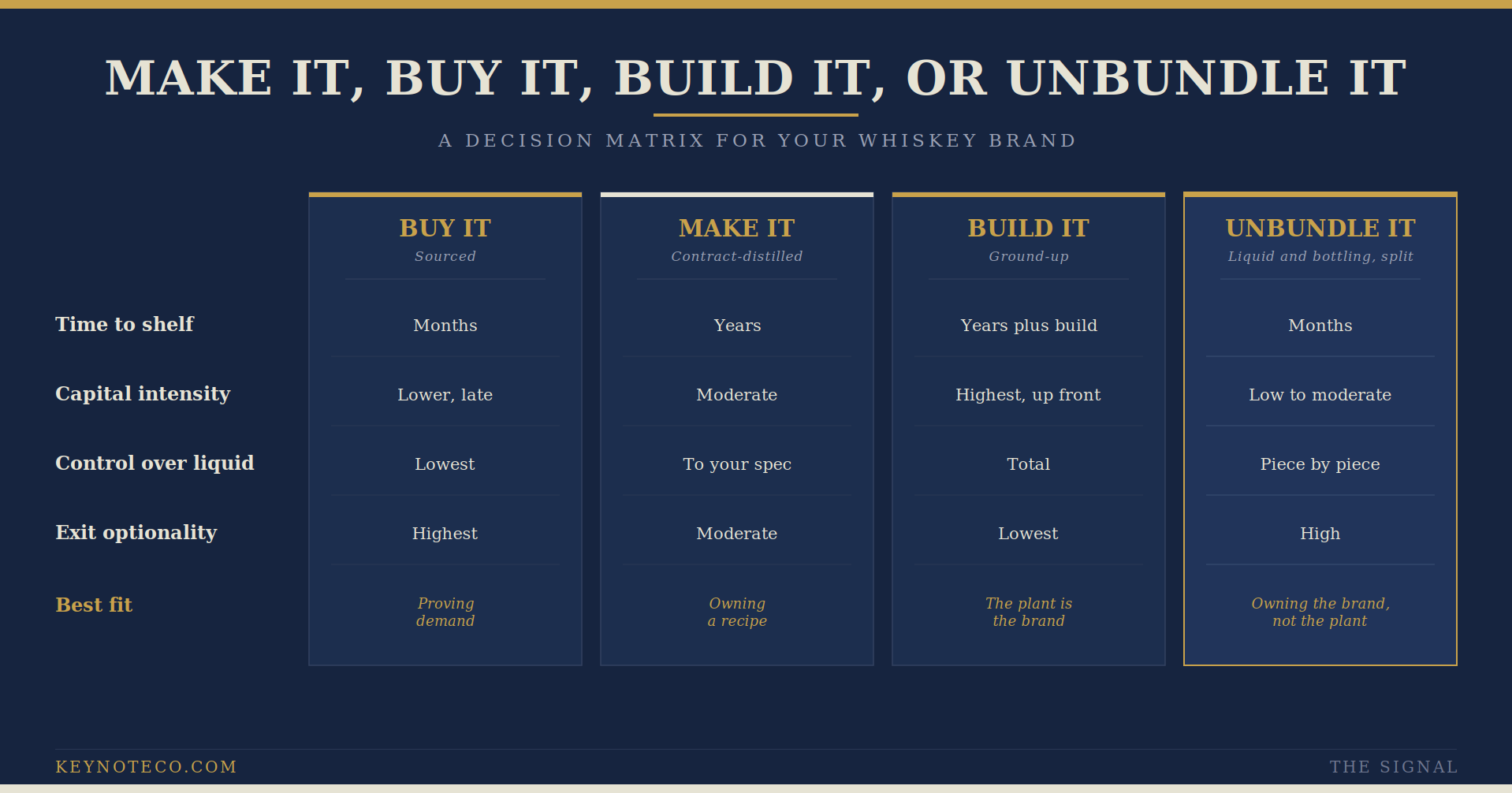
Read down the first three columns and a pattern emerges. The recognized paths sit on a single line that runs from light, fast, and reversible to heavy, slow, and permanent. Where you belong on that line is a function of where your brand is in its life, not of how serious you are. The fourth column does not sit on that line at all, and we will come back to why.
Where most operators actually belong, and when to move
For a brand that has not yet proven the market wants it, sourcing is almost always the right first move. It is the cheapest way to learn the most important thing you can learn, which is whether anyone will buy your whiskey at your price. Committing capital to contract distilling or, worse, to a distillery before you have that answer is how good liquid ends up in a warehouse no one is buying from.
Once demand is proven and a brand has runway, contract distilling becomes the natural next step. You move from selling whoever's whiskey you could source to selling the recipe that is yours, on a timeline you can plan around. This is the laddering logic in practice: prove it with sourced liquid, then commit to your own production once the demand is real and the longer-dated position is a calculated bet rather than a hope.
Ground-up is the last step, and for most brands it is optional forever. It makes sense when the distillery itself is part of the brand promise, when you have the capital to absorb years of negative cash flow, and when owning the plant unlocks something a partner cannot give you. For everyone else, the romance of owning a still is the most expensive feeling in the industry.
The fourth option the matrix does not draw as a wall
Here is what the three-column version of this decision hides. Sourcing, contract distilling, and building are not three sealed rooms you pick one of and live in. They describe two separate decisions that most operators have been treating as one: who controls the liquid, and who handles the physical work of turning that liquid into bottles on a truck.
Those two decisions come apart. You can source someone else's whiskey and have a production partner blend, finish, bottle, and ship it under your label, owning the brand without owning a single piece of equipment. You can contract-distill your own mash bill and hand off everything downstream to the same partner. You can do one thing for your first release and a different thing for your second. The path is not a commitment you make once at the door. It is a set of dials you set independently, and reset as the brand grows.
This is the version of the decision that the operators who understand the modern market are actually using, and it is why the old stigma around sourcing has stopped mattering. The question was never whether you made the liquid. It is whether you own a brand worth defending and chose intelligently about which parts of the work to keep and which to hand to someone who does them for a living. Unbundling gives you the speed and light footprint of sourcing with control you dial up exactly where it matters to your brand and nowhere it does not.
Which brings us to the thing that decides whether any of this works.
The distinction that matters more than the path
Here is the thing the matrix cannot show you, and it is the part that separates operators who build something durable from operators who simply make whiskey.
Whichever path you choose, the partner you choose to walk it with matters more than the path itself.
There is a version of every one of these relationships that is purely transactional. A barrel list and a wire transfer. Still time and an invoice. And there is a version that functions as an actual business partner: liquid expertise across the full production process, blending and finishing capability, bottling infrastructure, label and supply connections, and a team that has helped dozens of brands get from concept to shelf without learning every lesson the hard way. The gap between those two versions is wider than the gap between sourcing and contract distilling.
A new operator who sources from a transactional broker gets liquid and nothing else. A new operator who sources through a genuine full-service partner gets liquid, plus the accumulated judgment of everyone that partner has guided before. The path you pick determines your time to shelf and your capital exposure. The partner you pick determines whether you make the mistakes that have already been made by someone else, or make them yourself, in public, with your own money.
This is the part that does not appear on any decision matrix because it is not a variable you weigh against the others. It is the thing that determines whether any path you choose actually works. The infrastructure exists now to build a serious whiskey brand without owning a still, and the operators succeeding in this market are the ones who chose the right path for their stage and the right partner for the path.
Choose the path that fits where your brand actually is. Then choose the partner who has already walked it.
Thinking through which path fits the brand you are building? That conversation is what we do. Start here.