
Every whiskey brand claims a story. Few of them are the same kind of story.
That distinction matters more than most founders realize when they start. The story you lead with isn't just marketing — it's structural. It shapes who your customer is, how you acquire them, what your retail pitch sounds like, and whether your brand has legs once the launch buzz fades. Get it wrong and you spend years fighting upstream against it. Get it right and it does the selling for you.
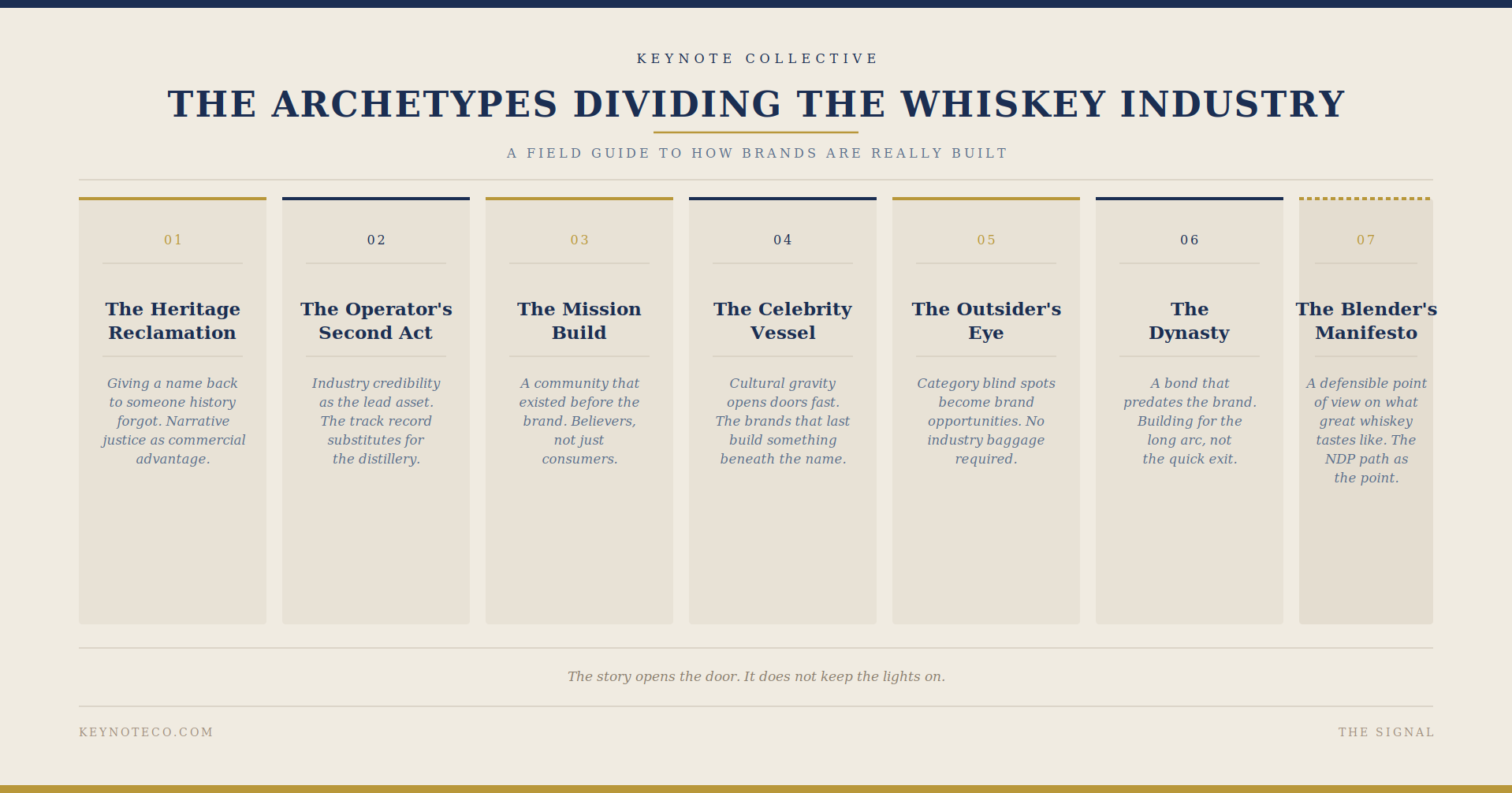
At Keynote, one of the first conversations we have with brand builders is about story. Not taglines, not label copy, but the foundational narrative architecture that determines how a brand gets built and who it gets built for. What follows is our framework for the archetypes we see most often, drawn from brands across the industry. It's not exhaustive. But it's a useful mirror.
At the end, there's something worth saying that most brand story articles skip — about what happens when even the best story meets a market that doesn't care how good it is.
THE HERITAGE RECLAMATION
Giving a name back to someone history forgot.
The story: There is a person, a place, or a chapter of American whiskey history that got written out of the official record. This brand is the correction.
The mechanism: Narrative justice is commercially powerful in a way that conventional brand positioning rarely achieves. When a brand gives consumers a reason to feel that their purchase matters beyond the liquid — that buying this bottle is a small act of acknowledgment — it creates a loyalty architecture that advertising money cannot replicate.
The defining example is Uncle Nearest (launched 2017). Built around Nathan "Nearest" Green, the first known African American master distiller, whose role in teaching Jack Daniel to distill went unacknowledged for over a century. Founder Fawn Weaver didn't just name a whiskey after him. She built an institution. The Nearest Green Foundation funds full scholarships for his descendants. A $50 million fund was established to back minority-owned spirits brands. The brand became the fastest-growing American whiskey in U.S. history and the best-selling African American-founded spirit of all time. The story didn't support the brand. The story was the brand.
The risk with this archetype is worth stating plainly: authenticity is non-negotiable. A reclamation story that feels manufactured or opportunistic will collapse faster than one that was never attempted. What made Uncle Nearest work commercially was a genuine personal connection to the research, a documented historical claim, and institutional ambition that outlasted the initial press cycle.
We return to Uncle Nearest later in this piece. There is more to say.
What it requires: A legitimate historical claim. Real depth. A founder willing to become the face of something larger than a product.
THE OPERATOR'S SECOND ACT
I built this once. Now I'm doing it again on my own terms.
The story: The founder has already proven themselves in this industry. The credibility is established. The second brand isn't about introductions — it's about independence, intention, and applying everything learned the first time without the constraints that came with it.
The mechanism: Credibility is the lead asset. The founder doesn't need to explain why they understand whiskey. The story becomes about what they chose to do with that knowledge when nobody was telling them what to do.
True Story, launched by Wes Henderson in 2024, is the clearest current example. Henderson co-founded Angel's Envy with his late father Lincoln in 2010 and helped build it into one of the defining premium bourbon brands of the modern era before its sale to Bacardi. He said he was retiring. He wasn't. Under his new Saga Spirits Group, backed by a $92.5 million investment and staffed almost entirely by his six sons, most of whom trained at Angel's Envy, Henderson launched True Story as an NDP, sourcing from multiple Kentucky distilleries and applying his signature cask finishing technique while building toward a new distillery in Versailles, Kentucky. The arc is a character study: a man who built something remarkable, handed it over, and immediately started building again. That's not a marketing message. That's a compulsion. In whiskey, where craft and reputation compound over decades, it carries weight that no advertising budget can manufacture.
What it requires: Real industry credentials and an honest story about why you're doing it again. This archetype works particularly well as an NDP entry point, because the founder's track record substitutes for the distillery's provenance.
THE MISSION BUILD
The brand exists to stand for something. The whiskey is the vehicle.
The story: There is a community, a cause, or a commitment that existed before the brand. The brand was built to serve it, not the other way around.
The mechanism: Affinity communities are the most durable consumer bases in spirits. When purchasing your brand feels like participation in something meaningful, you've moved the buyer from consumer to believer. That's a fundamentally different retention dynamic than taste preference alone.
Horse Soldier Bourbon (founded 2015) is the textbook case. Founded by retired Green Berets who were among the first soldiers deployed to Afghanistan after 9/11, some on horseback, three days after the towers fell. The bottles are pressed in molds made from steel salvaged from the World Trade Center. The company actively hires veterans. You are not buying a bourbon. You are buying a piece of something that began at ground zero.
Four Branches Bourbon (first release 2023) is the more recent and more precise execution of this archetype. Founded by veterans representing all four branches of the military simultaneously, with over 100 years of combined service, the brand was born from a specific act of remembrance: honoring a fellow Marine and CIA contractor who sacrificed his life in Iraq and became the first CIA contractor to receive the Intelligence Star. The tagline, "Sip to Remember," is a deliberate inversion of the culture of drinking to forget, which the founders see as a specific failure mode for veterans navigating transition. Partnering with Bardstown Bourbon Company on production and Bourbon Hall of Fame master distiller Steve Nally on the liquid, the brand raised over $400,000 for veteran nonprofits in less than 18 months. The Liberty Reserve, released in May 2026 — 1,776 individually numbered bottles honoring America's 250th anniversary — shows a brand that knows exactly how to activate its story at the right moment.
The line between Mission Build and Heritage Reclamation is thin. What distinguishes them: Heritage Reclamation looks backward and corrects the record. Mission Build looks forward into a community that exists now and can be activated now.
What it requires: An authentic relationship to the mission, not a donation line on the label. The consumers who care most about this archetype are among the most discerning in the category. They will find the seams if the commitment isn't real.
THE CELEBRITY VESSEL
A name with cultural gravity attaches to a liquid.
The story: Someone with fame, reach, and cultural relevance decides to build a whiskey brand. Distribution doors open faster. Press writes itself on launch day. The challenge is that celebrity attention is a depreciating asset — it generates the entry, not the loyalty.
SirDavis (launched 2024) is the most instructive current example because Beyoncé Knowles-Carter did something most celebrity spirits brands don't bother with: she rooted the brand in a genuine personal story. Named after her great-grandfather Davis Hogue, a Prohibition-era moonshiner who stashed whiskey in the knots of cedar trees for friends and kin, SirDavis is a joint venture with Moët Hennessy developed with master distiller Bill Lumsden. The liquid is credible. The story is personal. The heritage framing gives the celebrity vehicle something to stand on beyond the name alone.
The cautionary version of this archetype is well known even if the brand names change: a famous name attached to a sourced spirit with no narrative scaffolding beneath it. These brands spike on launch, plateau, and fade as the trade discovers there is nothing operationally or narratively distinctive behind the label. The honest question for any founder considering this archetype is what the brand becomes when the celebrity's cultural moment passes. If the answer is unclear, the launch window is being spent on awareness rather than foundation.
What it requires: Genuine involvement from the name in the brand's story, liquid, and creative direction, or a clear-eyed plan for building brand identity independent of the celebrity over time.
THE OUTSIDER'S EYE
Someone from outside the industry looks at bourbon with fresh eyes and builds something it wouldn't have built for itself.
The story: The founder comes from tech, design, finance, or another world entirely. They don't know the conventions, which turns out to be the advantage. They see what legacy players can't because they aren't constrained by how things have always been done.
The mechanism: Category blind spots become brand opportunities. An outsider is less likely to default to heritage positioning, standard label aesthetics, or conventional distribution strategy. That freedom, when channeled well, creates differentiation the category genuinely notices.
Blue Run Spirits (launched 2020, acquired by Molson Coors 2023) is the clearest proof of concept. Founded by a Nike designer, a Facebook executive, a political advisor, and a philanthropist, the brand was built on a single provocation: bourbon had never been marketed the way Supreme marketed sneakers. Scarcity, drop culture, design-forward packaging, a consumer who was younger and more diverse than the category had traditionally chased. They partnered with Bardstown Bourbon Company for production and brought in legendary former Four Roses master distiller Jim Rutledge to select and validate the liquid. Three years after launch, Molson Coors acquired them. The outsider's eye, backed by serious production infrastructure, went all the way to an exit.
What Blue Run demonstrates is not just that outsiders can succeed in whiskey. It's that the right production partner eliminates the one real disadvantage the outsider has. You don't need to know how to distill. You need to know how to build a brand, and you need a facility that can execute the liquid vision with the same level of craft you're promising in the marketing.
What it requires: A genuinely different point of view that leads to decisions the category wouldn't have made on its own, and the self-awareness to know what you don't know about the liquid and find the right partner to fill that gap.
THE DYNASTY
A family, or the equivalent of one, built something — and the next chapter is the story.
The story: The brand's credibility comes from continuity. The implied promise is that these people will still be here in twenty years because they were here twenty years ago.
The mechanism: Generational commitment signals patience in a category that is fundamentally about patience. A family story, whether by blood or by bond, communicates that the people behind the label are building for the long arc.
15 Stars Bourbon (debuted 2022) is one of the most instructive modern examples, and one of the most honest about how it actually works. Rick and Ricky Johnson, father and son, launched with genuine passion for bourbon and an equally genuine lack of blending expertise. Rather than pretend otherwise, they partnered with Brindiamo to access premium inventory ranging from new-make spirits all the way to 19-year-old bourbon, and built their blending capability from the ground up. The technique they developed, flavor-proofing, became a signature of the brand. Bardstown Bourbon Company handled production. Over 70 global awards in under two years. World's Best Finished Bourbon at the 2026 World Whiskies Awards. The dynasty here isn't measured in generations. It's measured in the commitment of two people who bet on each other, were honest about their limitations, and found the right infrastructure to execute against a long-term vision.
What it requires: A genuine relationship between the people behind the brand that predates the business and will survive the pressure of building one. The dynasty story only works if it's true.
THE BLENDER'S MANIFESTO
The brand exists because of a specific, defensible point of view about what great whiskey should taste like.
The story: This isn't about place, person, cause, or celebrity. It's about palate. The NDP structure isn't a workaround — it's the point. The brand earns its position through the accumulated credibility of consistently excellent curation and finishing decisions.
Four Gate Whiskey Company (founded 2019) is the clearest current example. Bob D'Antoni and Bill Straub, two friends with no formal industry background, built a brand entirely around finishing obsession. Every release is a different barrel-finishing experiment: rum casks, port pipes, Madeira, brandy, cognac, wine. The point of view is explicit and repeatable. Working with Bardstown Bourbon Company on sourcing and Kelvin Cooperage on custom barrel programs, they release in small numbered batches at barrel proof. By Batch 29, the brand has a collector following that most legacy distilleries would envy, built entirely on the credibility of the blending and finishing decisions.
Lost Lantern runs a parallel track at wider geographic scale. Founder Nora Ganley-Roper's Far-Flung Bourbon series blends straight bourbons from as many as six distilleries across six states into a single coherent expression. The proposition isn't provenance. It's the blender's eye, and that is a question only someone with a serious, defensible point of view can answer credibly.
What it requires: A demonstrably distinctive palate and the intellectual framework to explain it. The moment the releases feel random rather than intentional, the brand story collapses.
THE STORY IS NOT THE BUSINESS
What even the best brand narrative cannot protect you from.
Every archetype in this guide has produced brands that consumers love and the trade respects. Some of those brands are thriving. Some are not.
Uncle Nearest is the most important case study in American whiskey right now, not because of what it built, but because of what happened after. By every brand-building measure it did everything right. A genuine historical reclamation. A founder who became one of the most compelling voices in the industry. The fastest-growing American whiskey brand in U.S. history. A philanthropic infrastructure that embedded the brand in something larger than product. Then, in 2025, the brand was placed in receivership after allegations of defaulting on over $100 million in loans, with claims of overstated barrel inventory, collateral sold to cover other debts, and capital deployed in ways that violated loan covenants.
None of that negates the cultural contribution. But it illustrates a principle every brand builder needs to internalize early: brand equity and operational health are not the same variable. A story powerful enough to drive rapid growth can also obscure the warning signs beneath it, because the press cycle is focused on the narrative, investors are excited by the trajectory, and the operational strain is happening in the background where stories don't get told.
The American whiskey market compounds this dynamic. The boom-and-correction cycle of the last decade created enormous pressure on brands at every scale to grow faster than their foundations could support. Garrard County Distilling, once billed as Kentucky's largest all-new independent distillery, shut down in early 2025 with $26 million in debt. These are not brands that failed because of bad stories. They are brands where the operational machinery behind the story couldn't sustain the pace.
The brands that survive volatile cycles are the ones where story and infrastructure are built in parallel, where the founder is as rigorous about inventory management, capital structure, and distribution discipline as they are about brand narrative. The story opens the door. It does not keep the lights on.
This is the conversation Keynote's network has with founders before the label is designed, before the first barrel is laid down, before the distribution agreements are signed. What does the operational plan look like at 2x volume? What happens to the capital structure when the market softens? The archetypes in this guide are real and they work. The brands still standing are the ones that treated story as the entry point and operational discipline as the foundation.
Building a whiskey brand? The Keynote Collective works with founders at every stage, from first barrel to full distribution. Let's start the conversation.